Record Information
Version1.0
Creation Date2009-03-06 18:57:58 UTC
Update Date2026-04-05 10:22:29 UTC
Accession NumberCHEM000037
Identification
Common NameEndrin
ClassSmall Molecule
DescriptionEndrin has been found as a contaminant throughout the environment, including foodstuffs, fish, human milk, etc. Endrin belongs to the family of Benzoxepines. These are organic compounds containing a benzene ring fused to an oxepine ring (unsaturated seven-member heterocycle with one oxygen atom replacing a carbon atom.).
Contaminant Sources
  • Clean Air Act Chemicals
  • FooDB Chemicals
  • HPV EPA Chemicals
  • IARC Carcinogens Group 3
  • My Exposome Chemicals
  • STOFF IDENT Compounds
  • T3DB toxins
  • ToxCast & Tox21 Chemicals
Contaminant Type
  • Ether
  • Food Toxin
  • Metabolite
  • Organic Compound
  • Organochloride
  • Pesticide
  • Pollutant
  • Synthetic Compound
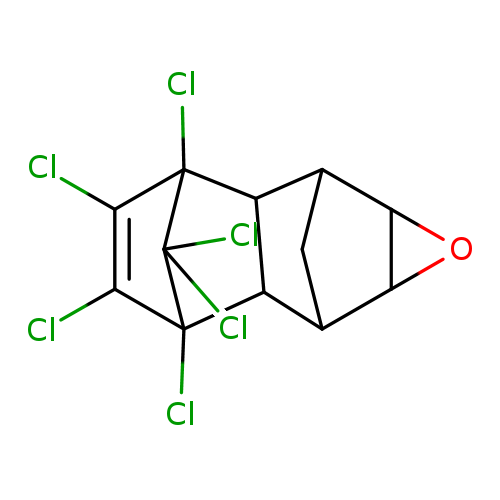
Chemical Structure
Thumb
Synonyms
ValueSource
3,4,5,6,9,9-hexachloro-1a,2,2a,3,6,6a,7,7a-octahydro-2,7:3,6-Dimethanonaph[2,3-b]oxirene, 9ciHMDB
Compd. 269HMDB
Compound 269HMDB
EN 57HMDB
EndrexHMDB
EndricolHMDB
Endrin 20 ecHMDB
Endrin and metabolitesHMDB
Endrin isomerHMDB
Endrin mixtureHMDB
EndrineHMDB
ent 17251HMDB
Experimental insecticide 269HMDB
hexachloroepoxyoctahydro-endo, endo-DimethanonaphthaleneHMDB
hexachloroepoxyoctahydro-endo,endo-DimethanonaphthaleneHMDB
hexachloroepoxyoctahydro-endo,endo-DimethanonapthaleneHMDB
HexadrinHMDB, MeSH
Latka 269HMDB
MendrinHMDB
NendrinHMDB
OktanexHMDB
OMS 197HMDB
SD 3419 IlloxolHMDB
StardrinHMDB
Stardrin 20HMDB
EndrinMeSH, HMDB
Chemical FormulaC12H8Cl6O
Average Molecular Mass380.909 g/mol
Monoisotopic Mass377.871 g/mol
CAS Registry Number72-20-8
IUPAC Name3,4,5,6,13,13-hexachloro-10-oxapentacyclo[6.3.1.1³,⁶.0²,⁷.0⁹,¹¹]tridec-4-ene
Traditional Nameendrin
SMILESClC1=C(Cl)C2(Cl)C3C4CC(C5OC45)C3C1(Cl)C2(Cl)Cl
InChI IdentifierInChI=1S/C12H8Cl6O/c13-8-9(14)11(16)5-3-1-2(6-7(3)19-6)4(5)10(8,15)12(11,17)18/h2-7H,1H2
InChI KeyDFBKLUNHFCTMDC-UHFFFAOYSA-N
Chemical Taxonomy
Description belongs to the class of organic compounds known as monoterpenoids. Monoterpenoids are compounds containing a chain of two isoprene units.
KingdomOrganic compounds
Super ClassLipids and lipid-like molecules
ClassPrenol lipids
Sub ClassMonoterpenoids
Direct ParentMonoterpenoids
Alternative Parents
Substituents
  • Monoterpenoid
  • Norbornane monoterpenoid
  • Oxepane
  • Oxane
  • Dialkyl ether
  • Oxirane
  • Ether
  • Oxacycle
  • Vinyl chloride
  • Vinyl halide
  • Organoheterocyclic compound
  • Haloalkene
  • Chloroalkene
  • Organooxygen compound
  • Hydrocarbon derivative
  • Alkyl chloride
  • Alkyl halide
  • Organic oxygen compound
  • Organohalogen compound
  • Organochloride
  • Aliphatic heteropolycyclic compound
Molecular FrameworkAliphatic heteropolycyclic compounds
External DescriptorsNot Available
Biological Properties
StatusDetected and Not Quantified
OriginExogenous
Cellular Locations
  • Membrane
Biofluid LocationsNot Available
Tissue LocationsNot Available
PathwaysNot Available
ApplicationsNot Available
Biological RolesNot Available
Chemical RolesNot Available
Physical Properties
StateSolid
AppearanceWhite powder.
Experimental Properties
PropertyValue
Melting Point226 - 230°C
Boiling PointNot Available
Solubility0.00025 mg/mL at 25°C
Predicted Properties
PropertyValueSource
Water Solubility0.0002 g/LALOGPS
logP4.98ALOGPS
logP3.95ChemAxon
logS-6.3ALOGPS
pKa (Strongest Basic)-4.2ChemAxon
Physiological Charge0ChemAxon
Hydrogen Acceptor Count1ChemAxon
Hydrogen Donor Count0ChemAxon
Polar Surface Area12.53 ŲChemAxon
Rotatable Bond Count0ChemAxon
Refractivity78.01 m³·mol⁻¹ChemAxon
Polarizability31.56 ųChemAxon
Number of Rings5ChemAxon
Bioavailability1ChemAxon
Rule of FiveYesChemAxon
Ghose FilterYesChemAxon
Veber's RuleYesChemAxon
MDDR-like RuleNoChemAxon
Spectra
Spectra
Spectrum TypeDescriptionSplash KeyView
Predicted GC-MSPredicted GC-MS Spectrum - GC-MS (Non-derivatized) - 70eV, Positivesplash10-053r-9424000000-cb0fe872a410e47acde6Spectrum
Predicted GC-MSPredicted GC-MS Spectrum - GC-MS (Non-derivatized) - 70eV, PositiveNot AvailableSpectrum
Predicted LC-MS/MSPredicted LC-MS/MS Spectrum - 10V, Positivesplash10-004i-0009000000-4e3ab80ba2cb5f78445dSpectrum
Predicted LC-MS/MSPredicted LC-MS/MS Spectrum - 20V, Positivesplash10-01t9-0009000000-47b57ee68ea2b95cb4a8Spectrum
Predicted LC-MS/MSPredicted LC-MS/MS Spectrum - 40V, Positivesplash10-003r-9124000000-f5c8679adbd456c1b9e6Spectrum
Predicted LC-MS/MSPredicted LC-MS/MS Spectrum - 10V, Negativesplash10-004i-0009000000-c15682ff19a328a64b01Spectrum
Predicted LC-MS/MSPredicted LC-MS/MS Spectrum - 20V, Negativesplash10-004i-0009000000-41a18726a0ad03aeb1f3Spectrum
Predicted LC-MS/MSPredicted LC-MS/MS Spectrum - 40V, Negativesplash10-0006-2209000000-4c9e51dcaa850bbc46a8Spectrum
Predicted LC-MS/MSPredicted LC-MS/MS Spectrum - 10V, Negativesplash10-004i-0009000000-e47142fe4621b138f5c3Spectrum
Predicted LC-MS/MSPredicted LC-MS/MS Spectrum - 20V, Negativesplash10-004i-0009000000-e47142fe4621b138f5c3Spectrum
Predicted LC-MS/MSPredicted LC-MS/MS Spectrum - 40V, Negativesplash10-004i-2009000000-263852a3083150cbd869Spectrum
Predicted LC-MS/MSPredicted LC-MS/MS Spectrum - 10V, Positivesplash10-004i-0009000000-bbc098baf89f49ef5fc5Spectrum
Predicted LC-MS/MSPredicted LC-MS/MS Spectrum - 20V, Positivesplash10-004i-0009000000-bbc098baf89f49ef5fc5Spectrum
Predicted LC-MS/MSPredicted LC-MS/MS Spectrum - 40V, Positivesplash10-004i-0009000000-9a33d936efbb436cac20Spectrum
MSMass Spectrum (Electron Ionization)splash10-004i-9350000000-1c4e09990ac9de8ef901Spectrum
Toxicity Profile
Route of ExposureOral (1)
Mechanism of ToxicityEndrin antagonizes the action of the neurotransmitter gamma-aminobutyric acid (GABA) acting at the GABA-A receptors, effectively blocking the GABA-induced uptake of chloride ions and causing hyperexcitability of the central nervous system. Endrin also inhibits Na+ K+ ATPase and Ca2+ and Mg2+ ATPase which are essential for the transport of calcium across membranes. This results in the accumulation of intracellular free calcium ions, which promotes release of neurotransmitters from storage vesicles, the subsequent depolarization of adjacent neurons, and the propagation of stimuli throughout the central nervous system. Endrin also causes increased lipid peroxidation, decreased membrane fluidity, and DNA damage in hepatocytes, but the exact mechanism is unknown. (6, 2)
MetabolismEndrin is absorbed orally and distributed primarily to the fat and skin. The major biotransformation product is anti-l 2-hydroxyendrin and the corresponding sulfate, as well as glucuronide metabolites. Anti- and syn-12-hydroxyendrin and 12-ketoendrin are the main toxic metabolites of endrin. Endrin and its metabolites are excreted in urine and feces. (2)
Toxicity ValuesLD50: 3 mg/kg (Oral, Rat) (7) LD50: 12 mg/kg (Dermal, Rat) (7)
Lethal DoseNot Available
Carcinogenicity (IARC Classification)3, not classifiable as to its carcinogenicity to humans. (4)
Uses/SourcesEndrin is used as a pesticide. (1)
Minimum Risk LevelIntermediate Oral: 0.002 mg/kg/day (3) Chronic Oral: 0.0003 mg/kg/day (3)
Health EffectsEndrin poisoning affects primarily the nerve system. Exposure causes various harmful effects including hyperexcitability, severe central nervous system damage, and death. Endrin is also believed to cause birth defects. (6, 2)
SymptomsSymptoms that may result from endrin poisoning are headaches, dizziness, nervousness, confusion, nausea, vomiting, and convulsions. (2)
TreatmentTreatment is symptomatic, aimed at controlling convulsions, coma, and respiratory depression. If ingested, gastric lavage may be performed, followed by administering activated charcoal powder. (5)
Concentrations
Not Available
DrugBank IDNot Available
HMDB IDHMDB0253129
FooDB IDFDB003234
Phenol Explorer IDNot Available
KNApSAcK IDC00000723
BiGG IDNot Available
BioCyc IDNot Available
METLIN IDNot Available
PDB IDNot Available
Wikipedia LinkEndrin
Chemspider ID2940
ChEBI IDNot Available
PubChem Compound IDNot Available
Kegg Compound IDNot Available
YMDB IDNot Available
ECMDB IDNot Available
References
Synthesis ReferenceNot Available
MSDSNot Available
General ReferencesNot Available