Record Information
Version1.0
Creation Date2009-03-06 18:57:58 UTC
Update Date2026-03-27 02:14:36 UTC
Accession NumberCHEM000036
Identification
Common Name3,3'-Dichlorobenzidine
ClassSmall Molecule
Description3,3'-Dichlorobenzidine is a manufactured chemical used in pigments for printing inks, textiles, plastics and enamels, paint, leather, and rubber. (3)
Contaminant Sources
  • Clean Air Act Chemicals
  • HPV EPA Chemicals
  • IARC Carcinogens Group 2B
  • STOFF IDENT Compounds
  • T3DB toxins
  • ToxCast & Tox21 Chemicals
Contaminant Type
  • Amine
  • Aromatic Hydrocarbon
  • Industrial Precursor/Intermediate
  • Industrial/Workplace Toxin
  • Organic Compound
  • Organochloride
  • Pollutant
  • Synthetic Compound
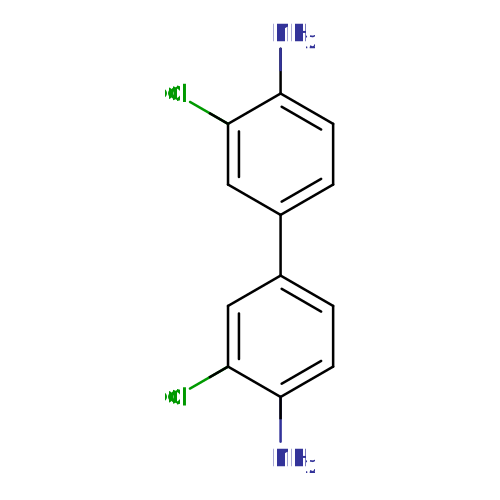
Chemical Structure
Thumb
Synonyms
ValueSource
3,3-DichlorobenzidineMeSH
3,3' DichlorobenzidineMeSH
3,3 DichlorobenzidineMeSH
Chemical FormulaC12H10Cl2N2
Average Molecular Mass253.127 g/mol
Monoisotopic Mass252.022 g/mol
CAS Registry Number91-94-1
IUPAC Name4-(4-amino-3-chlorophenyl)-2-chloroaniline
Traditional Name3,3'-dichlorobenzidine
SMILESNC1=CC=C(C=C1Cl)C1=CC=C(N)C(Cl)=C1
InChI IdentifierInChI=1S/C12H10Cl2N2/c13-9-5-7(1-3-11(9)15)8-2-4-12(16)10(14)6-8/h1-6H,15-16H2
InChI KeyHUWXDEQWWKGHRV-UHFFFAOYSA-N
Chemical Taxonomy
Description belongs to the class of organic compounds known as 3,3'-disubstituted benzidines. These are organic compounds containing a benzidine skeleton, which is substituted only at the 3- and 3'-positions.
KingdomOrganic compounds
Super ClassBenzenoids
ClassBenzene and substituted derivatives
Sub ClassBiphenyls and derivatives
Direct Parent3,3'-disubstituted benzidines
Alternative Parents
Substituents
  • 3,3'-disubstituted benzidine
  • Polychlorinated biphenyl
  • Chlorinated biphenyl
  • Aniline or substituted anilines
  • Halobenzene
  • Chlorobenzene
  • Aryl halide
  • Aryl chloride
  • Amine
  • Primary amine
  • Organopnictogen compound
  • Organonitrogen compound
  • Organochloride
  • Organohalogen compound
  • Organic nitrogen compound
  • Hydrocarbon derivative
  • Aromatic homomonocyclic compound
Molecular FrameworkAromatic homomonocyclic compounds
External Descriptors
Biological Properties
StatusDetected and Not Quantified
OriginExogenous
Cellular Locations
  • Membrane
Biofluid LocationsNot Available
Tissue LocationsNot Available
PathwaysNot Available
ApplicationsNot Available
Biological RolesNot Available
Chemical RolesNot Available
Physical Properties
StateSolid
AppearanceGray to purple crystalline solid.
Experimental Properties
PropertyValue
Melting Point132-133°C
Boiling PointNot Available
Solubility0.0031 mg/mL at 25 °C [BANERJEE,S et al. (1980)]
Predicted Properties
PropertyValueSource
Water Solubility0.014 g/LALOGPS
logP3.6ALOGPS
logP3.17ChemAxon
logS-4.3ALOGPS
pKa (Strongest Basic)2.95ChemAxon
Physiological Charge0ChemAxon
Hydrogen Acceptor Count2ChemAxon
Hydrogen Donor Count2ChemAxon
Polar Surface Area52.04 ŲChemAxon
Rotatable Bond Count1ChemAxon
Refractivity70.2 m³·mol⁻¹ChemAxon
Polarizability25.46 ųChemAxon
Number of Rings2ChemAxon
Bioavailability1ChemAxon
Rule of FiveYesChemAxon
Ghose FilterYesChemAxon
Veber's RuleNoChemAxon
MDDR-like RuleNoChemAxon
Spectra
Spectra
Spectrum TypeDescriptionSplash KeyView
Predicted GC-MSPredicted GC-MS Spectrum - GC-MS (Non-derivatized) - 70eV, Positivesplash10-0udi-1190000000-24f73fe267571f991098Spectrum
Predicted GC-MSPredicted GC-MS Spectrum - GC-MS (Non-derivatized) - 70eV, PositiveNot AvailableSpectrum
LC-MS/MSLC-MS/MS Spectrum - 40V, Positivesplash10-0f89-0950000000-e1d8ac0da5f211c65d65Spectrum
LC-MS/MSLC-MS/MS Spectrum - 50V, Positivesplash10-0f89-0920000000-a0acaebe463099f8c45dSpectrum
LC-MS/MSLC-MS/MS Spectrum - 30V, Positivesplash10-0udi-0390000000-a504760a935655f0ad6eSpectrum
LC-MS/MSLC-MS/MS Spectrum - 10V, Positivesplash10-0udi-0090000000-e14c2cb52287428839f2Spectrum
LC-MS/MSLC-MS/MS Spectrum - 35V, Positivesplash10-014i-0090000000-44b7f2dc526920f9e3e3Spectrum
Predicted LC-MS/MSPredicted LC-MS/MS Spectrum - 10V, Positivesplash10-0udi-0090000000-2da30e4a6dae2b880e5eSpectrum
Predicted LC-MS/MSPredicted LC-MS/MS Spectrum - 20V, Positivesplash10-0udi-0090000000-d03397aa4295ebecf622Spectrum
Predicted LC-MS/MSPredicted LC-MS/MS Spectrum - 40V, Positivesplash10-0itc-0950000000-5e7d8b51b049c2f2b5f9Spectrum
Predicted LC-MS/MSPredicted LC-MS/MS Spectrum - 10V, Negativesplash10-0udi-0090000000-1dcd7bb117f620a82c50Spectrum
Predicted LC-MS/MSPredicted LC-MS/MS Spectrum - 20V, Negativesplash10-0udi-0090000000-9f8332f0967b437df6baSpectrum
Predicted LC-MS/MSPredicted LC-MS/MS Spectrum - 40V, Negativesplash10-0uxr-1190000000-1624efdbdce5c9812b31Spectrum
Predicted LC-MS/MSPredicted LC-MS/MS Spectrum - 10V, Positivesplash10-0udi-0090000000-ad50fe771c7f0687b3ddSpectrum
Predicted LC-MS/MSPredicted LC-MS/MS Spectrum - 20V, Positivesplash10-0udi-0190000000-2d307ba5c02f87017af3Spectrum
Predicted LC-MS/MSPredicted LC-MS/MS Spectrum - 40V, Positivesplash10-016u-0950000000-98304cf4c8eb8aac02f1Spectrum
Predicted LC-MS/MSPredicted LC-MS/MS Spectrum - 10V, Negativesplash10-0udi-2090000000-a02e0d659edcaa44b74cSpectrum
Predicted LC-MS/MSPredicted LC-MS/MS Spectrum - 20V, Negativesplash10-0ue9-5190000000-b984bc558f86e89cff59Spectrum
Predicted LC-MS/MSPredicted LC-MS/MS Spectrum - 40V, Negativesplash10-001i-9100000000-dd9cc100e68f2a032543Spectrum
MSMass Spectrum (Electron Ionization)splash10-0udi-2490000000-b903f233a630b1efdf6dSpectrum
1D NMR1H NMR SpectrumNot AvailableSpectrum
1D NMR13C NMR SpectrumNot AvailableSpectrum
Toxicity Profile
Route of ExposureOral (3) ; inhalation (3) ; dermal (3)
Mechanism of Toxicity3,3’-Dichlorobenzidine's mechanism of toxicity derives mainly from the adduction of DNA by its metabolites. The formation of nitroso derivatives during metabolism, yielding a sulfinic acid amide with hemoglobin in erythrocytes, is suggested to be a mechanism for this adduct formation. 3,3’-Dichlorobenzidine can act on the aryl hydrocarbon receptor to induce the activity of cytochrome p-450 enzymes, which metabolize 3,3’-dichlorobenzidine, along with other polyhalogenated aromatics, into their toxic intermediates. (3, 1, 2)
Metabolism3,3'-Dichlorobenzidine is absorbed via ingestion, inhalation, and dermal routes. The major path of metabolism is believed to be N-acetylation via hepatic N-acetyltransferases, producing metabolites such as N-acetyl-3,3’-dichlorobenzidine and N,N-diacetyl-3,3’-dichlorobenzidine. 3,3'-Dichlorobenzidine may also be activated to toxic intermediates by certain cytochrome P-450 monooxygenases. Metabolites are excreted primarily in urine and to a lesser extent in faeces. (3)
Toxicity ValuesLD50: 8 g/kg (Dermal, Rat) (5) LD50: 3.82 g/kg (Oral, Rat) (5)
Lethal DoseNot Available
Carcinogenicity (IARC Classification)2B, possibly carcinogenic to humans. (4)
Uses/Sources3,3'-Dichlorobenzidine is used in pigments for printing inks, textiles, plastics and enamels, paint, leather, and rubber. (3)
Minimum Risk LevelNot Available
Health EffectsThe salt form of 3,3'-dichlorobenzidine may cause respiratory infections, stomach upset, and dermatitis. 3,3'-Dichlorobenzidine is also believed to be a possible carcinogen. (3)
SymptomsThe salt form of 3,3'-dichlorobenzidine may cause sore throat, respiratory infections, stomach upset, headache, dizziness, caustic burns, and dermatitis. (3)
TreatmentTreatment for 3,3'-dichlorobenzidine poisoning is usually supportive. (3)
Concentrations
Not Available
DrugBank IDNot Available
HMDB IDHMDB0245999
FooDB IDNot Available
Phenol Explorer IDNot Available
KNApSAcK IDNot Available
BiGG IDNot Available
BioCyc IDNot Available
METLIN IDNot Available
PDB IDNot Available
Wikipedia Link3,3'-Dichlorobenzidine
Chemspider ID6803
ChEBI IDNot Available
PubChem Compound IDNot Available
Kegg Compound IDC19225
YMDB IDNot Available
ECMDB IDNot Available
References
Synthesis ReferenceNot Available
MSDSNot Available
General ReferencesNot Available