Record Information
Version1.0
Creation Date2009-03-06 18:57:58 UTC
Update Date2026-03-26 20:09:28 UTC
Accession NumberCHEM000034
Identification
Common NameDisulfoton
ClassSmall Molecule
DescriptionDisulfoton is a manufactured organophosphate used as a pesticide. It is used mainly in agriculture to protect field and vegetable crops. (2)
Contaminant Sources
  • Clean Air Act Chemicals
  • EPA Endocrine Screening
  • HPV EPA Chemicals
  • My Exposome Chemicals
  • STOFF IDENT Compounds
  • T3DB toxins
  • ToxCast & Tox21 Chemicals
Contaminant Type
  • Ester
  • Ether
  • Household Toxin
  • Organic Compound
  • Organophosphate
  • Pesticide
  • Synthetic Compound
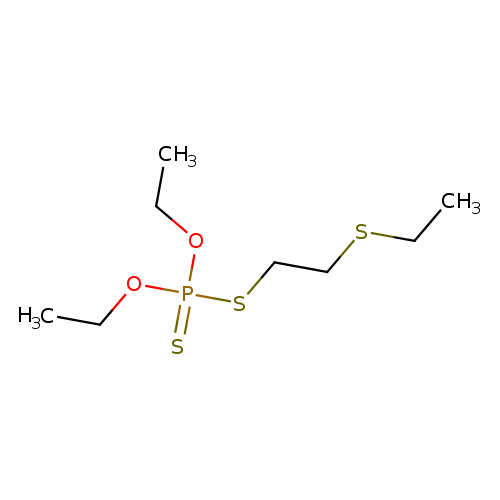
Chemical Structure
Thumb
Synonyms
ValueSource
EthylthiometonChEBI
O,O-Diethyl S-(2-(ethylthio)ethyl) dithiophosphateChEBI
O,O-Diethyl S-(2-ethylmercaptoethyl) dithiophosphateChEBI
Phosphorodithioic acid, O,O-diethyl S-(2-(ethylthio)ethyl) esterChEBI
S-[2-(Ethylsulfanyl)ethyl] O,O-dimethyl dithiophosphateChEBI
O,O-Diethyl S-(2-(ethylthio)ethyl) dithiophosphoric acidGenerator
O,O-Diethyl S-(2-ethylmercaptoethyl) dithiophosphoric acidGenerator
Phosphorodithioate, O,O-diethyl S-(2-(ethylthio)ethyl) esterGenerator
S-[2-(Ethylsulfanyl)ethyl] O,O-dimethyl dithiophosphoric acidGenerator
S-[2-(Ethylsulphanyl)ethyl] O,O-dimethyl dithiophosphateGenerator
S-[2-(Ethylsulphanyl)ethyl] O,O-dimethyl dithiophosphoric acidGenerator
DisulphotonGenerator
Di systonMeSH
DisystonMeSH
DemetonMeSH
Di-systonMeSH
ThiodemetonMeSH
Chemical FormulaC8H19O2PS3
Average Molecular Mass274.404 g/mol
Monoisotopic Mass274.028 g/mol
CAS Registry Number298-04-4
IUPAC NameO,O-diethyl {[2-(ethylsulfanyl)ethyl]sulfanyl}phosphonothioate
Traditional NameO,O-diethyl [2-(ethylsulfanyl)ethyl]sulfanylphosphonothioate
SMILESCCOP(=S)(OCC)SCCSCC
InChI IdentifierInChI=1S/C8H19O2PS3/c1-4-9-11(12,10-5-2)14-8-7-13-6-3/h4-8H2,1-3H3
InChI KeyDOFZAZXDOSGAJZ-UHFFFAOYSA-N
Chemical Taxonomy
Description belongs to the class of organic compounds known as dithiophosphate o-esters. These are o-ester derivatives of dithiophosphates, with the general structure RSP(O)(O)=S (R = organyl group).
KingdomOrganic compounds
Super ClassOrganic acids and derivatives
ClassOrganic dithiophosphoric acids and derivatives
Sub ClassDithiophosphate O-esters
Direct ParentDithiophosphate O-esters
Alternative Parents
Substituents
  • Dithiophosphate o-ester
  • Dithiophosphate s-ester
  • Dialkylthioether
  • Sulfenyl compound
  • Thioether
  • Organothiophosphorus compound
  • Organic oxygen compound
  • Hydrocarbon derivative
  • Organosulfur compound
  • Organooxygen compound
  • Aliphatic acyclic compound
Molecular FrameworkAliphatic acyclic compounds
External Descriptors
Biological Properties
StatusDetected and Not Quantified
OriginExogenous
Cellular Locations
  • Membrane
Biofluid LocationsNot Available
Tissue LocationsNot Available
PathwaysNot Available
Applications
Biological Roles
Chemical Roles
Physical Properties
StateLiquid
AppearanceColorless (pure) or dark yellow (technical grade) oil.
Experimental Properties
PropertyValue
Melting Point-25°C
Boiling PointNot Available
Solubility0.0163 mg/mL at 20 °C [BOWMAN,BT & SANS,WW (1983A)]
Predicted Properties
PropertyValueSource
Water Solubility0.0092 g/LALOGPS
logP4.11ALOGPS
logP3.03ChemAxon
logS-4.5ALOGPS
Physiological Charge0ChemAxon
Hydrogen Acceptor Count0ChemAxon
Hydrogen Donor Count0ChemAxon
Polar Surface Area18.46 ŲChemAxon
Rotatable Bond Count9ChemAxon
Refractivity74.12 m³·mol⁻¹ChemAxon
Polarizability29.47 ųChemAxon
Number of Rings0ChemAxon
Bioavailability1ChemAxon
Rule of FiveYesChemAxon
Ghose FilterYesChemAxon
Veber's RuleYesChemAxon
MDDR-like RuleNoChemAxon
Spectra
Spectra
Spectrum TypeDescriptionSplash KeyView
Predicted GC-MSPredicted GC-MS Spectrum - GC-MS (Non-derivatized) - 70eV, Positivesplash10-004i-9560000000-9bf6e1eb5b32189fa05eSpectrum
Predicted GC-MSPredicted GC-MS Spectrum - GC-MS (Non-derivatized) - 70eV, PositiveNot AvailableSpectrum
Predicted LC-MS/MSPredicted LC-MS/MS Spectrum - 10V, Positivesplash10-0079-9720000000-8bca5c80358331bf4e35Spectrum
Predicted LC-MS/MSPredicted LC-MS/MS Spectrum - 20V, Positivesplash10-01p9-9110000000-7495c438425dc6f45bd4Spectrum
Predicted LC-MS/MSPredicted LC-MS/MS Spectrum - 40V, Positivesplash10-03di-9000000000-63ab2f848de48c719200Spectrum
Predicted LC-MS/MSPredicted LC-MS/MS Spectrum - 10V, Negativesplash10-03di-8790000000-84a300807312877e3e26Spectrum
Predicted LC-MS/MSPredicted LC-MS/MS Spectrum - 20V, Negativesplash10-03di-9550000000-f4d95badb9b9d9a3c055Spectrum
Predicted LC-MS/MSPredicted LC-MS/MS Spectrum - 40V, Negativesplash10-0gwb-5930000000-a170a87f479eadd5c40eSpectrum
Predicted LC-MS/MSPredicted LC-MS/MS Spectrum - 10V, Positivesplash10-03dr-9310000000-0356a92bb41107ea8420Spectrum
Predicted LC-MS/MSPredicted LC-MS/MS Spectrum - 20V, Positivesplash10-03di-9400000000-123e612083412f9afbefSpectrum
Predicted LC-MS/MSPredicted LC-MS/MS Spectrum - 40V, Positivesplash10-03di-9000000000-c329bb1b708cbec1f626Spectrum
Predicted LC-MS/MSPredicted LC-MS/MS Spectrum - 10V, Negativesplash10-00di-0090000000-a7eefd959b907e8b58a7Spectrum
Predicted LC-MS/MSPredicted LC-MS/MS Spectrum - 20V, Negativesplash10-0h3r-1930000000-35347e0e3252d7f19126Spectrum
Predicted LC-MS/MSPredicted LC-MS/MS Spectrum - 40V, Negativesplash10-05fr-0900000000-e750208bc3eb6dc08abcSpectrum
MSMass Spectrum (Electron Ionization)splash10-002r-9200000000-18197bdfeb7682331a47Spectrum
1D NMR1H NMR SpectrumNot AvailableSpectrum
1D NMR13C NMR SpectrumNot AvailableSpectrum
Toxicity Profile
Route of ExposureOral (2) ; inhalation (2) ; dermal (2)
Mechanism of ToxicityDisulfoton is a cholinesterase or acetylcholinesterase (AChE) inhibitor. A cholinesterase inhibitor (or 'anticholinesterase') suppresses the action of acetylcholinesterase. Because of its essential function, chemicals that interfere with the action of acetylcholinesterase are potent neurotoxins, causing excessive salivation and eye-watering in low doses, followed by muscle spasms and ultimately death. Nerve gases and many substances used in insecticides have been shown to act by binding a serine in the active site of acetylcholine esterase, inhibiting the enzyme completely. Acetylcholine esterase breaks down the neurotransmitter acetylcholine, which is released at nerve and muscle junctions, in order to allow the muscle or organ to relax. The result of acetylcholine esterase inhibition is that acetylcholine builds up and continues to act so that any nerve impulses are continually transmitted and muscle contractions do not stop. Among the most common acetylcholinesterase inhibitors are phosphorus-based compounds, which are designed to bind to the active site of the enzyme. The structural requirements are a phosphorus atom bearing two lipophilic groups, a leaving group (such as a halide or thiocyanate), and a terminal oxygen.
MetabolismMetabolism of organophosphates occurs principally by oxidation, by hydrolysis via esterases and by reaction with glutathione. Demethylation and glucuronidation may also occur. Oxidation of organophosphorus pesticides may result in moderately toxic products. In general, phosphorothioates are not directly toxic but require oxidative metabolism to the proximal toxin. The glutathione transferase reactions produce products that are, in most cases, of low toxicity. Paraoxonase (PON1) is a key enzyme in the metabolism of organophosphates. PON1 can inactivate some organophosphates through hydrolysis. PON1 hydrolyzes the active metabolites in several organophosphates insecticides as well as, nerve agents such as soman, sarin, and VX. The presence of PON1 polymorphisms causes there to be different enzyme levels and catalytic efficiency of this esterase, which in turn suggests that different individuals may be more susceptible to the toxic effect of organophosphate exposure.
Toxicity ValuesLD50: 25 mg/kg (Dermal, Rat) (5) LD50: 6.8 mg/kg (Oral, Rat) (5) LD50: 9.4 mg/kg (Intraperitoneal, Rat) (5)
Lethal DoseNot Available
Carcinogenicity (IARC Classification)No indication of carcinogenicity to humans (not listed by IARC).
Uses/SourcesDisulfoton is used mainly in agriculture to protect field and vegetable crops, as well as some fruit and nut crops. It may also be used in smaller quantities on home and garden plants and for mosquito control in swamps. (2)
Minimum Risk LevelAcute Inhalation: 0.006 mg/m3 (3) Intermediate Inhalation: 0.0002 mg/m3 (3) Acute Oral: 0.001 mg/kg/day (3) Intermediate Oral: 0.00009 mg/kg/day (3) Chronic Oral: 0.00006 mg/kg/day (3)
Health EffectsAcute exposure to cholinesterase inhibitors can cause a cholinergic crisis characterized by severe nausea/vomiting, salivation, sweating, bradycardia, hypotension, collapse, and convulsions. Increasing muscle weakness is a possibility and may result in death if respiratory muscles are involved. Accumulation of ACh at motor nerves causes overstimulation of nicotinic expression at the neuromuscular junction. When this occurs symptoms such as muscle weakness, fatigue, muscle cramps, fasciculation, and paralysis can be seen. When there is an accumulation of ACh at autonomic ganglia this causes overstimulation of nicotinic expression in the sympathetic system. Symptoms associated with this are hypertension, and hypoglycemia. Overstimulation of nicotinic acetylcholine receptors in the central nervous system, due to accumulation of ACh, results in anxiety, headache, convulsions, ataxia, depression of respiration and circulation, tremor, general weakness, and potentially coma. When there is expression of muscarinic overstimulation due to excess acetylcholine at muscarinic acetylcholine receptors symptoms of visual disturbances, tightness in chest, wheezing due to bronchoconstriction, increased bronchial secretions, increased salivation, lacrimation, sweating, peristalsis, and urination can occur. Certain reproductive effects in fertility, growth, and development for males and females have been linked specifically to organophosphate pesticide exposure. Most of the research on reproductive effects has been conducted on farmers working with pesticides and insecticdes in rural areas. In females menstrual cycle disturbances, longer pregnancies, spontaneous abortions, stillbirths, and some developmental effects in offspring have been linked to organophosphate pesticide exposure. Prenatal exposure has been linked to impaired fetal growth and development. Neurotoxic effects have also been linked to poisoning with OP pesticides causing four neurotoxic effects in humans: cholinergic syndrome, intermediate syndrome, organophosphate-induced delayed polyneuropathy (OPIDP), and chronic organophosphate-induced neuropsychiatric disorder (COPIND). These syndromes result after acute and chronic exposure to OP pesticides.
SymptomsDepending on the amount of disulfoton that enters the body, effects on the nervous system, such as narrowing of the pupils, vomiting, diarrhea, drooling, difficulty in breathing, tremors, convulsions, and even death may occur. Skin contact with disulfoton may cause weakness and fatigue. (2)
TreatmentIf the compound has been ingested, rapid gastric lavage should be performed using 5% sodium bicarbonate. For skin contact, the skin should be washed with soap and water. If the compound has entered the eyes, they should be washed with large quantities of isotonic saline or water. In serious cases, atropine and/or pralidoxime should be administered. Anti-cholinergic drugs work to counteract the effects of excess acetylcholine and reactivate AChE. Atropine can be used as an antidote in conjunction with pralidoxime or other pyridinium oximes (such as trimedoxime or obidoxime), though the use of '-oximes' has been found to be of no benefit, or possibly harmful, in at least two meta-analyses. Atropine is a muscarinic antagonist, and thus blocks the action of acetylcholine peripherally.

Concentrations
Not Available
DrugBank IDNot Available
HMDB IDNot Available
FooDB IDNot Available
Phenol Explorer IDNot Available
KNApSAcK IDNot Available
BiGG IDNot Available
BioCyc IDNot Available
METLIN IDNot Available
PDB IDNot Available
Wikipedia LinkDisulfoton
Chemspider IDNot Available
ChEBI ID38661
PubChem Compound ID3118
Kegg Compound IDC18400
YMDB IDNot Available
ECMDB IDNot Available
References
Synthesis ReferenceNot Available
MSDSNot Available
General References
1. https://www.ncbi.nlm.nih.gov/pubmed/?term=15294458
2. https://www.ncbi.nlm.nih.gov/pubmed/?term=22818267
3. https://www.ncbi.nlm.nih.gov/pubmed/?term=22968680
4. https://www.ncbi.nlm.nih.gov/pubmed/?term=23303564