Record Information
Version1.0
Creation Date2009-03-06 18:57:56 UTC
Update Date2026-03-31 19:48:43 UTC
Accession NumberCHEM000023
Identification
Common NameBenzidine
ClassSmall Molecule
DescriptionBenzidine is the organic compound with the formula (C6H4NH2)2. it is an aromatic amine. It is prepared in a two step process from nitrobenzene. First, the nitrobenzene is converted to 1,2-diphenylhydrazine, usually using iron powder as the reducing agent. Treatment of this hydrazine with mineral acids induces a rearrangement reaction to 4,4'-benzidine. Smaller amounts of other isomers are also formed. The benzidine rearrangement, which proceeds intramolecularly, is a classic mechanistic puzzle in organic chemistry. This aromatic amine is a component of a test for cyanide and also in the production of dyes. Benzidine has been linked to bladder and pancreatic cancer. Since August 2010 benzidine dyes are included in the EPA's List of Chemicals of Concern.
Contaminant Sources
  • Clean Air Act Chemicals
  • HPV EPA Chemicals
  • IARC Carcinogens Group 1
  • My Exposome Chemicals
  • STOFF IDENT Compounds
  • T3DB toxins
  • ToxCast & Tox21 Chemicals
Contaminant Type
  • Amine
  • Aromatic Hydrocarbon
  • Industrial/Workplace Toxin
  • Metabolite
  • Organic Compound
  • Pollutant
  • Synthetic Compound
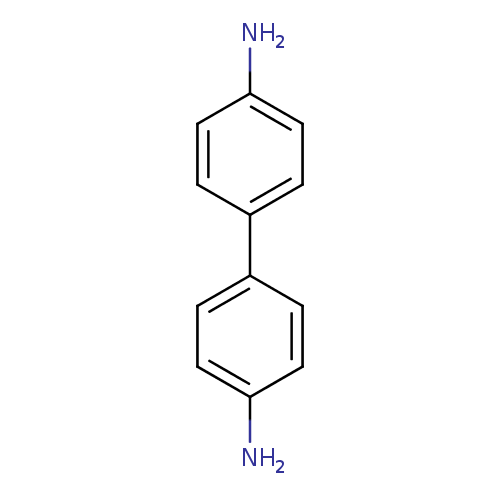
Chemical Structure
Thumb
Synonyms
ValueSource
(1,1'-Biphenyl)-4,4'-diamineChEBI
4,4'-BianilineChEBI
4,4'-BiphenyldiamineChEBI
4,4'-BiphenylenediamineChEBI
4,4'-Diamino-1,1'-biphenylChEBI
4,4'-DiaminobiphenylChEBI
4,4'-DiaminodiphenylChEBI
4,4'-DiphenylenediamineChEBI
C.I. azoic diazo component 112ChEBI
p,P'-bianilineChEBI
p,P'-diaminodiphenylChEBI
p-DiaminodiphenylChEBI
4'-Amino[1,1'-biphenyl]-4-ylamine (acd/name 4.0)HMDB
4, 4'-BiphenylenediamineHMDB
Biphenyl -4,4'-ylenediamineHMDB
Fast corinth base bHMDB
p,P'-diaminobiphenylHMDB
p,P'-dianilineHMDB
p,p-BianilineHMDB
Rcra waste number u021HMDB
[1,1'-Biphenyl]-4,4'-diamineHMDB
[1,1'-Biphenyl]-4,4'-diamine (acd/name 4.0)HMDB
{[1,} 1'-biphenyl]-4,4'-diamineHMDB
Benzidine hydrochlorideHMDB
Benzidine acetateHMDB
Benzidine monosulfateHMDB
Benzidine dihydrochlorideHMDB
Chemical FormulaC12H12N2
Average Molecular Mass184.237 g/mol
Monoisotopic Mass184.100 g/mol
CAS Registry Number92-87-5
IUPAC Name4-(4-aminophenyl)aniline
Traditional Namebenzidine
SMILESNC1=CC=C(C=C1)C1=CC=C(N)C=C1
InChI IdentifierInChI=1S/C12H12N2/c13-11-5-1-9(2-6-11)10-3-7-12(14)8-4-10/h1-8H,13-14H2
InChI KeyHFACYLZERDEVSX-UHFFFAOYSA-N
Chemical Taxonomy
Description belongs to the class of organic compounds known as benzidines. These are organic compounds containing the benzidine skeleton, made up of a biphenyl ring system substituted at the 4- and 4'-positions with a unsubstituted amine group.
KingdomOrganic compounds
Super ClassBenzenoids
ClassBenzene and substituted derivatives
Sub ClassBiphenyls and derivatives
Direct ParentBenzidines
Alternative Parents
Substituents
  • Benzidine
  • Aniline or substituted anilines
  • Organic nitrogen compound
  • Organopnictogen compound
  • Hydrocarbon derivative
  • Primary amine
  • Organonitrogen compound
  • Amine
  • Aromatic homomonocyclic compound
Molecular FrameworkAromatic homomonocyclic compounds
External Descriptors
Biological Properties
StatusDetected and Not Quantified
OriginExogenous
Cellular Locations
  • Cytoplasm
  • Extracellular
Biofluid LocationsNot Available
Tissue LocationsNot Available
PathwaysNot Available
ApplicationsNot Available
Biological RolesNot Available
Chemical RolesNot Available
Physical Properties
StateSolid
AppearanceWhite powder.
Experimental Properties
PropertyValue
Melting Point120°C
Boiling PointNot Available
Solubility0.322 mg/mL at 25°C
Predicted Properties
PropertyValueSource
Water Solubility0.4 g/LALOGPS
logP1.59ALOGPS
logP1.96ChemAxon
logS-2.7ALOGPS
pKa (Strongest Basic)4.73ChemAxon
Physiological Charge0ChemAxon
Hydrogen Acceptor Count2ChemAxon
Hydrogen Donor Count2ChemAxon
Polar Surface Area52.04 ŲChemAxon
Rotatable Bond Count1ChemAxon
Refractivity60.6 m³·mol⁻¹ChemAxon
Polarizability21.05 ųChemAxon
Number of Rings2ChemAxon
Bioavailability1ChemAxon
Rule of FiveYesChemAxon
Ghose FilterYesChemAxon
Veber's RuleNoChemAxon
MDDR-like RuleNoChemAxon
Spectra
Spectra
Spectrum TypeDescriptionSplash KeyView
GC-MSGC-MS Spectrum - EI-B (Non-derivatized)splash10-001i-1900000000-46465bd7171400dfc550Spectrum
Predicted GC-MSPredicted GC-MS Spectrum - GC-MS (Non-derivatized) - 70eV, Positivesplash10-001i-1900000000-da909bc8739471b977a5Spectrum
Predicted GC-MSPredicted GC-MS Spectrum - GC-MS (Non-derivatized) - 70eV, PositiveNot AvailableSpectrum
LC-MS/MSLC-MS/MS Spectrum - ESI-ITFT , positivesplash10-000i-0900000000-36d2368b345aadafe472Spectrum
LC-MS/MSLC-MS/MS Spectrum - ESI-ITFT , positivesplash10-014i-0900000000-c5c1dcbf033fe4c60c26Spectrum
LC-MS/MSLC-MS/MS Spectrum - ESI-ITFT , positivesplash10-014i-0900000000-d5e0ce902c65a7d945a1Spectrum
LC-MS/MSLC-MS/MS Spectrum - ESI-ITFT , positivesplash10-014i-0900000000-527aa9bf80b633185478Spectrum
LC-MS/MSLC-MS/MS Spectrum - ESI-ITFT , positivesplash10-014i-0900000000-d455d086a3a2f8252f64Spectrum
LC-MS/MSLC-MS/MS Spectrum - ESI-ITFT , positivesplash10-000i-0900000000-8a4d7fb696a251cf65f2Spectrum
LC-MS/MSLC-MS/MS Spectrum - ESI-ITFT , positivesplash10-000i-0900000000-9894faa005f0ae52dc53Spectrum
LC-MS/MSLC-MS/MS Spectrum - ESI-ITFT , positivesplash10-014r-0900000000-0b8ab8dbf459dd778773Spectrum
LC-MS/MSLC-MS/MS Spectrum - ESI-ITFT , positivesplash10-014i-0900000000-497ea7121bf277833bb6Spectrum
LC-MS/MSLC-MS/MS Spectrum - ESI-ITFT , positivesplash10-014i-0900000000-6af8bfce4a24520cec00Spectrum
LC-MS/MSLC-MS/MS Spectrum - ESI-ITFT , positivesplash10-014i-0900000000-91749c0c5e4ef529093eSpectrum
LC-MS/MSLC-MS/MS Spectrum - ESI-ITFT , positivesplash10-014i-0900000000-49669661b9cd83218acbSpectrum
LC-MS/MSLC-MS/MS Spectrum - ESI-ITFT , positivesplash10-014i-0900000000-a61957b37aba01bd4ee0Spectrum
LC-MS/MSLC-MS/MS Spectrum - ESI-ITFT , positivesplash10-00kr-1900000000-c4a27064ec37d84f0355Spectrum
LC-MS/MSLC-MS/MS Spectrum - APCI-ITFT , positivesplash10-014i-0900000000-5f242ea7ebce9e040adfSpectrum
LC-MS/MSLC-MS/MS Spectrum - APCI-ITFT , positivesplash10-014i-0900000000-6ee5a8d18cf5b5e520e3Spectrum
LC-MS/MSLC-MS/MS Spectrum - APCI-ITFT , positivesplash10-014i-0900000000-bfa10df85ed8a268fafcSpectrum
LC-MS/MSLC-MS/MS Spectrum - APCI-ITFT , positivesplash10-014i-0900000000-fccc4a1798517c633d70Spectrum
LC-MS/MSLC-MS/MS Spectrum - APCI-ITFT , positivesplash10-014i-0900000000-df132eef993f855e82edSpectrum
Predicted LC-MS/MSPredicted LC-MS/MS Spectrum - 10V, Positivesplash10-000i-0900000000-7e5627a8d5f62d9aa7e0Spectrum
Predicted LC-MS/MSPredicted LC-MS/MS Spectrum - 20V, Positivesplash10-000i-0900000000-39f67531ed6e9de51adeSpectrum
Predicted LC-MS/MSPredicted LC-MS/MS Spectrum - 40V, Positivesplash10-056r-1900000000-9a354370a58dd3accdf9Spectrum
Predicted LC-MS/MSPredicted LC-MS/MS Spectrum - 10V, Negativesplash10-001i-0900000000-9d1762ff8a90d7425837Spectrum
Predicted LC-MS/MSPredicted LC-MS/MS Spectrum - 20V, Negativesplash10-001i-0900000000-9d1762ff8a90d7425837Spectrum
Predicted LC-MS/MSPredicted LC-MS/MS Spectrum - 40V, Negativesplash10-001i-2900000000-caeb9b49b279ff5b605fSpectrum
MSMass Spectrum (Electron Ionization)splash10-001i-2900000000-0c34c7cea9097e35e7e1Spectrum
Toxicity Profile
Route of ExposureOral (6) ; inhalation (6) ; dermal (6)
Mechanism of ToxicityN-acetylated benzidine metabolites are believed to form adducts with nucleic acids. Carcinogenesis is initiated when they are activated by peroxidation by prostaglandin H synthetase, oxidation by cytochrome P-450, or O-esterification by O-acetyltransferase or N,O-acetyltransferase. Benzidine has also been shown to bind to RNA and hemoglobin. (6, 1)
MetabolismBenzidine is absorpted following inhalation, oral, and dermal routes of exposure. Metabolism involves multiple and complex enzymatic pathways, including cytochrome P-450 and flavin monooxygenase systems, peroxidation by prostaglandin H synthase, and oxidation by lipoxygenases. The main reactions involved are N-acetylation, N-oxidation, and N-glucuronidation. Benzidine and its metabolites are excreted in the urine and faeces. (6)
Toxicity ValuesLD50: 309 mg/kg (Oral, Rat) (8) LD50: 110 mg/kg (Intraperitoneal, Mouse) (8)
Lethal DoseNot Available
Carcinogenicity (IARC Classification)1, carcinogenic to humans. (7)
Uses/SourcesBenzidine was used to produce dyes for cloth, paper, and leather. (6)
Minimum Risk LevelNot Available
Health EffectsBenzidine is a known human carcinogen, most often associated with cancer of the urinary bladder. If benzidine comes in contact with skin it may cause a skin allergy. Liver, kidney, immune, and neurological effects have also been observed in animals exposed to benzidine. (6)
SymptomsNot Available
TreatmentNot Available
Concentrations
Not Available
DrugBank IDNot Available
HMDB IDHMDB0041835
FooDB IDNot Available
Phenol Explorer IDNot Available
KNApSAcK IDNot Available
BiGG IDNot Available
BioCyc IDNot Available
METLIN IDNot Available
PDB IDNot Available
Wikipedia LinkBenzidine
Chemspider ID6844
ChEBI ID80495
PubChem Compound ID7111
Kegg Compound IDC16444
YMDB IDNot Available
ECMDB IDNot Available
References
Synthesis ReferenceNot Available
MSDSNot Available
General References
1. https://www.ncbi.nlm.nih.gov/pubmed/?term=15317128
2. https://www.ncbi.nlm.nih.gov/pubmed/?term=21089809
3. https://www.ncbi.nlm.nih.gov/pubmed/?term=23766236
4. https://www.ncbi.nlm.nih.gov/pubmed/?term=25151432
5. https://www.ncbi.nlm.nih.gov/pubmed/?term=25281283
6. https://www.ncbi.nlm.nih.gov/pubmed/?term=25757908
7. https://www.ncbi.nlm.nih.gov/pubmed/?term=7341968
8. Arlt M, Scheffler A, Suske I, Eschner M, Saragi TP, Salbeck J, Fuhrmann-Lieker T: Bipolar redox behaviour, field-effect mobility and transistor switching of the low-molecular azo glass AZOPD. Phys Chem Chem Phys. 2010 Nov 7;12(41):13828-34. doi: 10.1039/c0cp00643b. Epub 2010 Sep 20.
9. Lardo MM, Diaz NB, Artaza JR, Carbia CD, Nazer R, Valdez R: [Vitamin E as protective agent against hemolysis in leprosy patients under dapsone treatment]. Medicina (B Aires). 1997;57(2):150-4.