Record Information
Version1.0
Creation Date2009-03-06 18:57:55 UTC
Update Date2026-05-14 19:09:15 UTC
Accession NumberCHEM000009
Identification
Common NameChloroform
ClassSmall Molecule
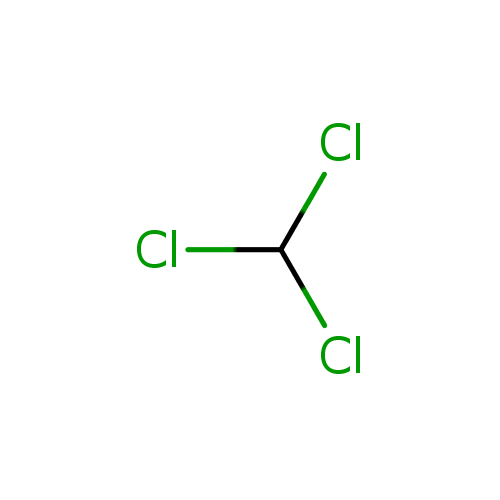
DescriptionChloroform is found in spearmint. Indirect food additive arising from adhesives and polymers Chloroform is a common solvent in the laboratory because it is relatively unreactive, miscible with most organic liquids, and conveniently volatile. Chloroform is used as a solvent in the pharmaceutical industry and for producing dyes and pesticides. Chloroform is an effective solvent for alkaloids in their base form and thus plant material is commonly extracted with chloroform for pharmaceutical processing. For example, it is commercially used to extract morphine from poppies and scopolamine from Datura plants. Chloroform containing deuterium (heavy hydrogen), CDCl3, is a common solvent used in NMR spectroscopy. It can be used to bond pieces of acrylic glass (also known under the trade names Perspex and Plexiglas). Chloroform is a solvent of phenol:chloroform:isoamyl alcohol 25:24:1 is used to dissolve non-nucleic acid biomolecules in DNA and RNA extractions. Chloroform is the organic compound with formula CHCl3. It does not undergo combustion in air, although it will burn when mixed with more flammable substances. It is a member of a group of compounds known as trihalomethanes. Chloroform has myriad uses as a reagent and a solvent. It is also considered an environmental hazard. Several million tons are produced annually. The output of this process is a mixture of the four chloromethanes: chloromethane, dichloromethane, chloroform (trichloromethane), and carbon tetrachloride, which are then separated by distillation. Chloroform has been shown to exhibit antifoaming agent, anti-coagulant, depressant, analgesic and anti-fungal functions (3, 4, 5, 6, 7). Chloroform belongs to the family of Organochlorides. These are organic compounds containing a chlorine atom.
Contaminant Sources
  • Clean Air Act Chemicals
  • Disinfection Byproducts
  • EAFUS Chemicals
  • FooDB Chemicals
  • HMDB Contaminants - Feces
  • HPV EPA Chemicals
  • IARC Carcinogens Group 2B
  • OECD HPV Chemicals
  • STOFF IDENT Compounds
  • T3DB toxins
  • Tobacco Smoke Compounds
  • ToxCast & Tox21 Chemicals
Contaminant Type
  • Cigarette Toxin
  • Drug
  • Food Toxin
  • Household Toxin
  • Human Neurotoxin
  • Indicator and Reagent
  • Industrial/Workplace Toxin
  • Metabolite
  • Organic Compound
  • Organochloride
  • PMT
  • Pesticide
  • Pollutant
  • Solvent
  • Synthetic Compound
Chemical Structure
Thumb
Synonyms
ValueSource
1,1,1-TrichloromethaneChEBI
CHCL3ChEBI
ChloroformeChEBI
Chloroformium pro narcosiChEBI
TrichlormethanChEBI
TrichloromethaneChEBI
CFHMDB
Chloroform, acsHMDB
Chloroformwith amyleneHMDB
Chloroformwith ethanolHMDB
CloroformioHMDB
Formyl trichlorideHMDB
Freon 20HMDB
HSDB 56HMDB
Methane trichlorideHMDB
Methenyl chlorideHMDB
Methenyl trichlorideHMDB
Methyl trichlorideHMDB
Methylidyne trichlorideHMDB
R 20 (Refrigerant)HMDB
R 20HMDB
R20HMDB
Refrigerant R20HMDB
TCMHMDB
TrichloormethaanHMDB
trichloro-MethaneHMDB
TrichloroformHMDB
Trichloromethane, 9ciHMDB
Trichloromethyl radicalHMDB
TriclorometanoHMDB
Chemical FormulaCHCl3
Average Molecular Mass119.378 g/mol
Monoisotopic Mass117.914 g/mol
CAS Registry Number67-66-3
IUPAC Nametrichloromethane
Traditional Namechloroform
SMILESClC(Cl)Cl
InChI IdentifierInChI=1S/CHCl3/c2-1(3)4/h1H
InChI KeyHEDRZPFGACZZDS-UHFFFAOYSA-N
Chemical Taxonomy
Description belongs to the class of organic compounds known as trihalomethanes. These are organic compounds in which exactly three of the four hydrogen atoms of methane (CH4) are replaced by halogen atoms.
KingdomOrganic compounds
Super ClassOrganohalogen compounds
ClassAlkyl halides
Sub ClassHalomethanes
Direct ParentTrihalomethanes
Alternative Parents
Substituents
  • Trihalomethane
  • Hydrocarbon derivative
  • Organochloride
  • Alkyl chloride
  • Aliphatic acyclic compound
Molecular FrameworkAliphatic acyclic compounds
External Descriptors
Biological Properties
StatusDetected and Not Quantified
OriginExogenous
Cellular Locations
  • Cytoplasm
  • Extracellular
Biofluid LocationsNot Available
Tissue LocationsNot Available
PathwaysNot Available
Applications
Biological Roles
Chemical Roles
Physical Properties
StateLiquid
AppearanceColorless liquid.
Experimental Properties
PropertyValue
Melting Point-63.2°C
Boiling Point61.2 °C
Solubility7.95 mg/mL at 25°C
Predicted Properties
PropertyValueSource
Water Solubility6.95 g/LALOGPS
logP1.67ALOGPS
logP1.83ChemAxon
logS-1.2ALOGPS
Physiological Charge0ChemAxon
Hydrogen Acceptor Count0ChemAxon
Hydrogen Donor Count0ChemAxon
Polar Surface Area0 ŲChemAxon
Rotatable Bond Count0ChemAxon
Refractivity21.37 m³·mol⁻¹ChemAxon
Polarizability8.52 ųChemAxon
Number of Rings0ChemAxon
Bioavailability1ChemAxon
Rule of FiveYesChemAxon
Ghose FilterNoChemAxon
Veber's RuleYesChemAxon
MDDR-like RuleNoChemAxon
Spectra
Spectra
Spectrum TypeDescriptionSplash KeyView
GC-MSGC-MS Spectrum - EI-B (Non-derivatized)splash10-001r-9000000000-d2165f9bfa5b3898f4d5Spectrum
GC-MSGC-MS Spectrum - EI-B (Non-derivatized)splash10-001r-9000000000-375900f120fe0ebf7c58Spectrum
GC-MSGC-MS Spectrum - EI-B (Non-derivatized)splash10-001r-9000000000-4c60f1e48cbdf424460bSpectrum
GC-MSGC-MS Spectrum - EI-B (Non-derivatized)splash10-001r-9000000000-d2165f9bfa5b3898f4d5Spectrum
GC-MSGC-MS Spectrum - EI-B (Non-derivatized)splash10-001r-9000000000-375900f120fe0ebf7c58Spectrum
GC-MSGC-MS Spectrum - EI-B (Non-derivatized)splash10-001r-9000000000-4c60f1e48cbdf424460bSpectrum
Predicted GC-MSPredicted GC-MS Spectrum - GC-MS (Non-derivatized) - 70eV, Positivesplash10-0159-5900000000-13ef070956a851ce2784Spectrum
Predicted GC-MSPredicted GC-MS Spectrum - GC-MS (Non-derivatized) - 70eV, PositiveNot AvailableSpectrum
Predicted LC-MS/MSPredicted LC-MS/MS Spectrum - 10V, Positivesplash10-014i-0900000000-6f9c7451d6c432351608Spectrum
Predicted LC-MS/MSPredicted LC-MS/MS Spectrum - 20V, Positivesplash10-014i-0900000000-6f9c7451d6c432351608Spectrum
Predicted LC-MS/MSPredicted LC-MS/MS Spectrum - 40V, Positivesplash10-014i-0900000000-6f9c7451d6c432351608Spectrum
Predicted LC-MS/MSPredicted LC-MS/MS Spectrum - 10V, Negativesplash10-014i-0900000000-cb9a1ddc44b429b7e0f1Spectrum
Predicted LC-MS/MSPredicted LC-MS/MS Spectrum - 20V, Negativesplash10-014i-0900000000-cb9a1ddc44b429b7e0f1Spectrum
Predicted LC-MS/MSPredicted LC-MS/MS Spectrum - 40V, Negativesplash10-014i-0900000000-cb9a1ddc44b429b7e0f1Spectrum
Predicted LC-MS/MSPredicted LC-MS/MS Spectrum - 10V, Positivesplash10-014i-0900000000-530b2b8e87acbcec8fdcSpectrum
Predicted LC-MS/MSPredicted LC-MS/MS Spectrum - 20V, Positivesplash10-014i-0900000000-530b2b8e87acbcec8fdcSpectrum
Predicted LC-MS/MSPredicted LC-MS/MS Spectrum - 40V, Positivesplash10-001i-9000000000-1066c6b02caa36264b10Spectrum
Predicted LC-MS/MSPredicted LC-MS/MS Spectrum - 10V, Negativesplash10-014i-0900000000-93c2c20fb25adc5e905aSpectrum
Predicted LC-MS/MSPredicted LC-MS/MS Spectrum - 20V, Negativesplash10-014i-0900000000-93c2c20fb25adc5e905aSpectrum
Predicted LC-MS/MSPredicted LC-MS/MS Spectrum - 40V, Negativesplash10-014i-0900000000-93c2c20fb25adc5e905aSpectrum
MSMass Spectrum (Electron Ionization)splash10-001r-9000000000-dd0c3059130b9d8e0a21Spectrum
1D NMR1H NMR SpectrumNot AvailableSpectrum
1D NMR13C NMR SpectrumNot AvailableSpectrum
1D NMR1H NMR SpectrumNot AvailableSpectrum
1D NMR13C NMR SpectrumNot AvailableSpectrum
1D NMR1H NMR SpectrumNot AvailableSpectrum
1D NMR13C NMR SpectrumNot AvailableSpectrum
1D NMR1H NMR SpectrumNot AvailableSpectrum
1D NMR13C NMR SpectrumNot AvailableSpectrum
1D NMR1H NMR SpectrumNot AvailableSpectrum
1D NMR13C NMR SpectrumNot AvailableSpectrum
1D NMR1H NMR SpectrumNot AvailableSpectrum
1D NMR13C NMR SpectrumNot AvailableSpectrum
1D NMR1H NMR SpectrumNot AvailableSpectrum
1D NMR13C NMR SpectrumNot AvailableSpectrum
1D NMR1H NMR SpectrumNot AvailableSpectrum
1D NMR13C NMR SpectrumNot AvailableSpectrum
1D NMR1H NMR SpectrumNot AvailableSpectrum
1D NMR13C NMR SpectrumNot AvailableSpectrum
1D NMR1H NMR SpectrumNot AvailableSpectrum
1D NMR13C NMR SpectrumNot AvailableSpectrum
1D NMR1H NMR SpectrumNot AvailableSpectrum
1D NMR13C NMR SpectrumNot AvailableSpectrum
Toxicity Profile
Route of ExposureOral (8) ; inhalation (8)
Mechanism of ToxicityChloroform and the reactive intermediates of chloroform metabolism, especially phosgene, bind covalently and irreversibly to cellular macromolecules and cause cellular damage within the liver and kidney. While the exact mechanism is unknown, phosgene has been shown to react with molecules such as cysteine, deplete hepatic glutathione, form adducts with microsomal proteins, and elevate hepatic enzyme levels. Chloroform has also been shown to block HERG potassium channels, causing cardiac arrest. (8, 1, 2)
MetabolismChloroform in absorbed mainly through the lungs. Once in the body it concentrates in lipid-containing organs such as the adipose tissue, the central nervous system, kidney and liver. It is eliminated unchanged in expired air or metabolized by the liver via a cytochrome P450 mechanism and excreted in the urine and faeces. (1)
Toxicity ValuesLD50: 36 mg/kg (Oral, Mouse) (11) LD50: 623 mg/kg (Intraperitoneal, Mouse) (11) LD50: 704 mg/kg (Subcutaneous, Mouse) (11) LC50: 47 702 mg/m3 over 4 hours (Inhalation, Rat) (11)
Lethal Dose10 mL for an adult human. (12)
Carcinogenicity (IARC Classification)2B, possibly carcinogenic to humans. (10)
Uses/SourcesChloroform is found in refridgerants and is also used as a solvent or reagent in the synthesis of other chemicals. Exposure may results from contact with contaminated air or water. (8)
Minimum Risk LevelAcute Inhalation: 0.1 ppm (9) Intermediate Inhalation: 0.05 ppm (9) Chronic Inhalation: 0.02 ppm (9) Acute Oral: 0.3 mg/kg/day (9) Intermediate Oral: 0.1 mg/kg/day (9) Chronic Oral: 0.1 mg/kg/day (9)
Health EffectsChronic exposure to chloroform causes liver and kidney damage. It has also been shown to have detrimental reproductive and developmental effects. Skin contact with large amounts of chloroform results in sores. Inhaling large amounts of chloroform can cause central nervous system and respiratory depression, and may be fatal. (8)
SymptomsAcute inhalation of chloroform causes dizziness, fatigue, and headache. (8)
TreatmentThere is no known antidote for chloroform. Exposure is usually handled with symptomatic treatment. (8)
Concentrations
Not Available
DrugBank IDDB11387
HMDB IDHMDB0029596
FooDB IDFDB000760
Phenol Explorer IDNot Available
KNApSAcK IDNot Available
BiGG IDNot Available
BioCyc IDCPD-843
METLIN IDNot Available
PDB IDMCH
Wikipedia LinkChloroform
Chemspider ID5977
ChEBI ID35255
PubChem Compound ID6212
Kegg Compound IDC13827
YMDB IDNot Available
ECMDB IDNot Available
References
Synthesis ReferenceNot Available
MSDSLink
General References
1. https://www.ncbi.nlm.nih.gov/pubmed/?term=10379014
2. https://www.ncbi.nlm.nih.gov/pubmed/?term=15583552
3. https://www.ncbi.nlm.nih.gov/pubmed/?term=20051454
4. https://www.ncbi.nlm.nih.gov/pubmed/?term=21850127
5. https://www.ncbi.nlm.nih.gov/pubmed/?term=23093177
6. https://www.ncbi.nlm.nih.gov/pubmed/?term=8476536
7. https://www.ncbi.nlm.nih.gov/pubmed/?term=8625290
8. Firth NL, Ross DA, Thonney ML: Comparison of ether and chloroform for Soxhlet extraction of freeze-dried animal tissues. J Assoc Off Anal Chem. 1985 Nov-Dec;68(6):1228-31.
9. Exner T, Papadopoulos G, Sahman N, Koutts J: Solvent extraction of test plasmas for improved recovery of lupus anticoagulant activity. Thromb Haemost. 1990 Aug 13;64(1):121-3.
10. Barker JL, Gainer H: Pentobarbital: selective depression of excitatory postsynaptic potentials. Science. 1973 Nov 16;182(4113):720-2.
11. Huo Y, Guo C, Zhang QY, Chen WS, Zheng HC, Rahman K, Qin LP: Antinociceptive activity and chemical composition of constituents from Caragana microphylla seeds. Phytomedicine. 2007 Feb;14(2-3):143-6. Epub 2006 May 16.
12. Svetaz L, Tapia A, Lopez SN, Furlan RL, Petenatti E, Pioli R, Schmeda-Hirschmann G, Zacchino SA: Antifungal chalcones and new caffeic acid esters from Zuccagnia punctata acting against soybean infecting fungi. J Agric Food Chem. 2004 Jun 2;52(11):3297-300.
13. Yannai, Shmuel. (2004) Dictionary of food compounds with CD-ROM: Additives, flavors, and ingredients. Boca Raton: Chapman & Hall/CRC.