Record Information
Version1.0
Creation Date2009-03-06 18:57:54 UTC
Update Date2026-03-27 02:16:21 UTC
Accession NumberCHEM000004
Identification
Common NameVinyl chloride
ClassSmall Molecule
DescriptionVinyl chloride is a man-made organic compound, formed when other substances such as trichloroethane, trichloroethylene, and tetrachloroethylene are broken down. In its monomer form it is acutely hazardous, thus it is primarily used for the production of polymers. At room temperature it is a flammable, colorless gas with a sweet odor, but it is easily condensed and usually stored as a liquid. It is one ingredient of cigarette.(2)
Contaminant Sources
  • Clean Air Act Chemicals
  • HPV EPA Chemicals
  • IARC Carcinogens Group 1
  • IARC Carcinogens Group 3
  • OECD HPV Chemicals
  • STOFF IDENT Compounds
  • T3DB toxins
  • Tobacco Smoke Compounds
Contaminant Type
  • Cigarette Toxin
  • Household Toxin
  • Industrial Precursor/Intermediate
  • Industrial/Workplace Toxin
  • Organic Compound
  • Organochloride
  • Pollutant
  • Synthetic Compound
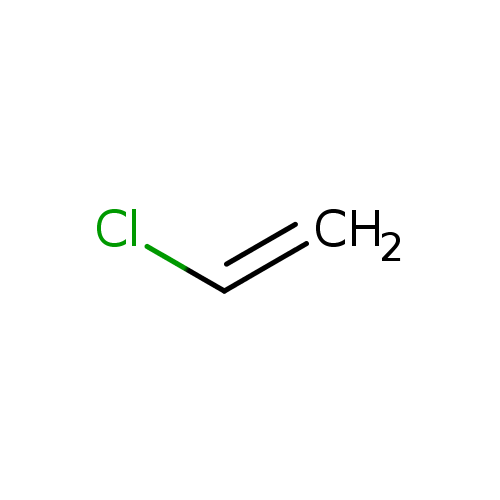
Chemical Structure
Thumb
Synonyms
ValueSource
ChloroethyleneChEBI
Chlorure de vinyleChEBI
CloroetilenoChEBI
Cloruro de viniloChEBI
Ethylene monochlorideChEBI
MonochloroetheneChEBI
MonochloroethyleneChEBI
Monovinyl chlorideChEBI
VCChEBI
VinylchloridChEBI
Chloride, vinylMeSH
Chemical FormulaC2H3Cl
Average Molecular Mass62.498 g/mol
Monoisotopic Mass61.992 g/mol
CAS Registry Number75-01-4
IUPAC Namechloroethene
Traditional Namevinyl chloride
SMILESClC=C
InChI IdentifierInChI=1S/C2H3Cl/c1-2-3/h2H,1H2
InChI KeyBZHJMEDXRYGGRV-UHFFFAOYSA-N
Chemical Taxonomy
Description belongs to the class of organic compounds known as vinyl chlorides. These are vinyl halides in which a chlorine atom is bonded to an sp2-hybridised carbon atom.
KingdomOrganic compounds
Super ClassOrganohalogen compounds
ClassVinyl halides
Sub ClassVinyl chlorides
Direct ParentVinyl chlorides
Alternative Parents
Substituents
  • Chloroalkene
  • Haloalkene
  • Vinyl chloride
  • Hydrocarbon derivative
  • Organochloride
  • Aliphatic acyclic compound
Molecular FrameworkAliphatic acyclic compounds
External Descriptors
Biological Properties
StatusDetected and Not Quantified
OriginExogenous
Cellular Locations
  • Cytoplasm
  • Extracellular
Biofluid LocationsNot Available
Tissue LocationsNot Available
PathwaysNot Available
ApplicationsNot Available
Biological Roles
Chemical RolesNot Available
Physical Properties
StateGas
AppearanceColorless gas, usually stored as a liquid.
Experimental Properties
PropertyValue
Melting Point-153.7°C
Boiling Point-13.37 °C
Solubility8.8 mg/mL at 25 °C [DELASSUS,PT & SCHMIDT,DD (1981)]
Predicted Properties
PropertyValueSource
Water Solubility6.5 g/LALOGPS
logP1.43ALOGPS
logP1.42ChemAxon
logS-0.98ALOGPS
Physiological Charge0ChemAxon
Hydrogen Acceptor Count0ChemAxon
Hydrogen Donor Count0ChemAxon
Polar Surface Area0 ŲChemAxon
Rotatable Bond Count0ChemAxon
Refractivity14.78 m³·mol⁻¹ChemAxon
Polarizability5.56 ųChemAxon
Number of Rings0ChemAxon
Bioavailability1ChemAxon
Rule of FiveYesChemAxon
Ghose FilterNoChemAxon
Veber's RuleYesChemAxon
MDDR-like RuleNoChemAxon
Spectra
Spectra
Spectrum TypeDescriptionSplash KeyView
Predicted GC-MSPredicted GC-MS Spectrum - GC-MS (Non-derivatized) - 70eV, Positivesplash10-03fr-9000000000-cca8f8fb8494bd1cf945Spectrum
Predicted GC-MSPredicted GC-MS Spectrum - GC-MS (Non-derivatized) - 70eV, PositiveNot AvailableSpectrum
Predicted LC-MS/MSPredicted LC-MS/MS Spectrum - 10V, Positivesplash10-03di-9000000000-cd1df297631e1a165422Spectrum
Predicted LC-MS/MSPredicted LC-MS/MS Spectrum - 20V, Positivesplash10-03di-9000000000-cd1df297631e1a165422Spectrum
Predicted LC-MS/MSPredicted LC-MS/MS Spectrum - 40V, Positivesplash10-03di-9000000000-36421f5fe75dfb1341c2Spectrum
Predicted LC-MS/MSPredicted LC-MS/MS Spectrum - 10V, Negativesplash10-03di-9000000000-6b1c92ce0fdbd22550acSpectrum
Predicted LC-MS/MSPredicted LC-MS/MS Spectrum - 20V, Negativesplash10-03di-9000000000-f51fccd78cdc9b0d9db4Spectrum
Predicted LC-MS/MSPredicted LC-MS/MS Spectrum - 40V, Negativesplash10-03di-9000000000-40d1f731f008007abaa5Spectrum
MSMass Spectrum (Electron Ionization)splash10-01t9-9000000000-05a88d6b1243ffe92502Spectrum
1D NMR1H NMR SpectrumNot AvailableSpectrum
1D NMR13C NMR SpectrumNot AvailableSpectrum
1D NMR1H NMR SpectrumNot AvailableSpectrum
1D NMR13C NMR SpectrumNot AvailableSpectrum
1D NMR1H NMR SpectrumNot AvailableSpectrum
1D NMR13C NMR SpectrumNot AvailableSpectrum
1D NMR1H NMR SpectrumNot AvailableSpectrum
1D NMR13C NMR SpectrumNot AvailableSpectrum
1D NMR1H NMR SpectrumNot AvailableSpectrum
1D NMR13C NMR SpectrumNot AvailableSpectrum
1D NMR1H NMR SpectrumNot AvailableSpectrum
1D NMR13C NMR SpectrumNot AvailableSpectrum
1D NMR1H NMR SpectrumNot AvailableSpectrum
1D NMR13C NMR SpectrumNot AvailableSpectrum
Toxicity Profile
Route of ExposureOral (2) ; inhalation (2) ; dermal (2)
Mechanism of ToxicityVinyl chloride poisoning exhibits many of the characteristics of autoimmune diseases. This is believed to be the result of a reactive vinyl chloride intermediate metabolite binding to an immunoglobulin, altering the protein and initiating an immune response. The metabolites of vinyl chloride, especially choloroethylene oxide, are mutagenic and act by covalently binding to DNA. This produces cyclic etheno-adducts, which cause base-pair transitions during transcription and DNA crosslinks. Metabolites also may cause oxidative stress and affecting tumor supressor genes, as vinyl chloride has been known to produce specific mutations in the p53 and Ki-ras genes. Vinyl chloride metabolites are also believed to exert toxic effects in the liver by covalently binding to liver proteins, resulting in cellular toxicity. (2, 1)
MetabolismVinyl chloride absorbed primarily via inhalation or ingestion is rapidly distributed throughout the body. It is metabolized mainly in the liver by cytochrome P-450 monooxygenases, first into chloroethylene oxide, then into chloroacetaldehyde, which are the main toxic metabolites. Chloroacetaldehyde is further converted into chloroethanol and monochloroacetic acid. Detoxification occurs in conjunction with glutathione, producing mainly thiodiglycolic acid, which is excreted in the urine. At high doses vinyl chloride may also be excreted by exhalation. (2, 5)
Toxicity ValuesLD50: 500 mg/kg (Oral, Rat) (6)
Lethal Dose120 000 ppm for an adult human. (7)
Carcinogenicity (IARC Classification)1, carcinogenic to humans. (4)
Uses/SourcesVinyl chloride is used primarily to make polyvinyl chloride (PVC). PVC is used in a variety of plastic products, such as pipes, wire and cable coatings, and packaging materials. Small amounts of vinyl chloride is sometimes used in furniture and automobile upholstery, wall coverings, housewares, and automotive parts. (2)
Minimum Risk LevelAcute Inhalation: 0.5 ppm (3) Intermediate Inhalation: 0.03 ppm (3) Chronic Oral: 0.003 mg/kg/day (3)
Health EffectsExposure to vinyl chloride results in liver damage, nerve damage, and immune reactions, as well as depression of the central nervous system and cardiac arrhythmias. Long term exposure may result in damage to the sperm and testes of males. Vinyl chloride is also a known carcinogen. (2)
SymptomsSymptoms of acute vinyl chloride exposure include headache, nausea, dizziness, and drowsiness, possibly resulting in loss of conciousness, coma or cardiac arrhythmias at higher levels. Chronic exposure can lead to lung and kidney irritation, inhibition of bloodclotting, numbness and pain in the fingers, memory loss, and sleep disurbances. (2)
TreatmentVinyl chloride has no tested antidote. Poisoning is usually handled by preventing further exposure and treating the observed symptoms. (2)

Concentrations
Not Available
DrugBank IDNot Available
HMDB IDHMDB0259823
FooDB IDNot Available
Phenol Explorer IDNot Available
KNApSAcK IDNot Available
BiGG IDNot Available
BioCyc IDNot Available
METLIN IDNot Available
PDB IDNot Available
Wikipedia LinkChloroethene
Chemspider ID6098
ChEBI ID28509
PubChem Compound IDNot Available
Kegg Compound IDC19508
YMDB IDNot Available
ECMDB IDNot Available
References
Synthesis ReferenceNot Available
MSDSNot Available
General References
1. https://www.ncbi.nlm.nih.gov/pubmed/?term=15989139
2. https://www.ncbi.nlm.nih.gov/pubmed/?term=18678006